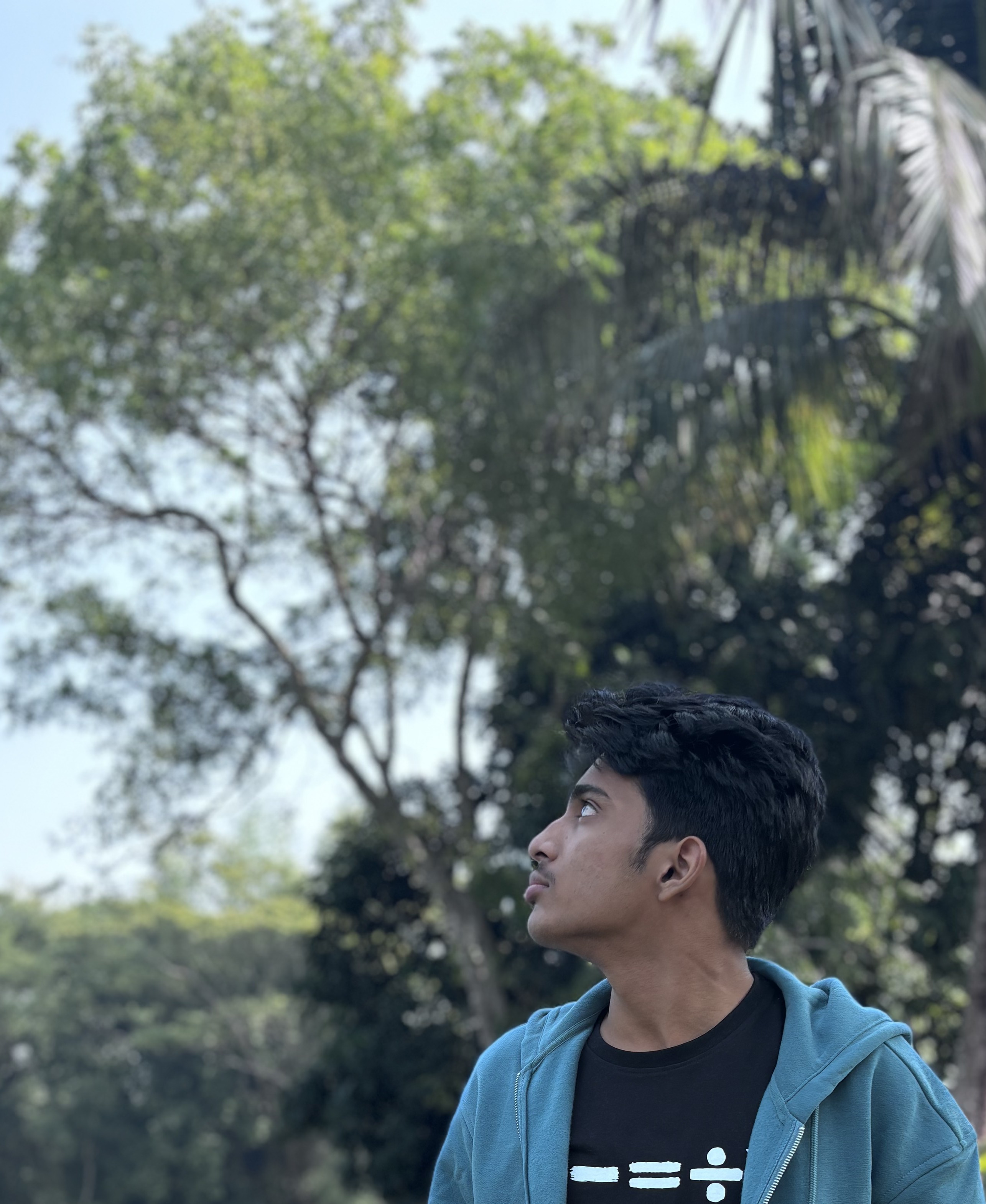
16 · West Bengal, India · Independent Researcher · Builder
I am a deep-tech founder, independent researcher, and grassroots organizer from Purba Medinipur. I build systems that move the state — because technology is only real when it serves the people closest to the ground.
Every year, something happens that defies calculation. The rain. The soil. The wind. The sun. Something always betrays us. — Kartik Chandra Hazra, farmer, Purba Medinipur
Who I Am
I grew up in a village surrounded by five kilometers of paddy fields, watching the world through a window. My father and grandfather were my only playmates for ten years. I wanted to be an astrophysicist. But by eleven I realized the world I wanted to explore might not exist by the time I was old enough to reach it.
So I stopped watching and started building. Not because I had perfect resources — I built my first IoT nodes by scavenging chips from a government lab. Not because I had institutional backing — I cold-emailed professors at Columbia and Harvard. Not because I had permission — I walked into government offices and asked the right questions until the machinery moved.
01
Technology exists because some soul first imagined it — from philosophy, from rage, from refusal. Code without soul is just math. I build the soul first, then the system.
02
Among ordinary people there are Auls, Bauls, Kartabhajas — sects whose wisdom runs deeper than any textbook. I do not consider it beneath my dignity to learn from people institutions have called small.
03
Perfect conditions are a luxury. I build with whatever is available, prove the model at small scale, then use that proof to move the machinery. Execution speed cannot be replicated overnight.
04
Farmers were the first intelligence system humanity built to make life easier. They fed every civilization that came after. They deserve partners, not punishments.
Technical Stack & Research Capabilities
Core Project · OSHWA IN000084
India bleeds $24 billion annually to stubble burning — not because farmers are careless, but because they are trapped in a 14-day harvest window with zero logistical support and a state surveillance system that is architecturally blind. INSAT gives 24/7 coverage but blurry pixels. Polar satellites give resolution but a 4-hour lag. The government sees smoke, sends police, fines the farmer. It criminalizes survival. I built SATARK to intercept the matchstick before it is struck.
In 62 days — while sitting my 10th board examinations — I secured five government mandates, deployed a 50-node IoT grid across Kolaghat Block, activated 30+ field Guardians, and published peer-reviewed research. SATARK is certified open-source hardware under CERN-OHL-S-2.0 and GPL-3.0-OR-LATER.
Open Source Hardware · Certified
IN000084 · March 20, 2026CERN-OHL-S-2.0 · GPL-3.0-OR-LATER
Engine 01
Fuses multi-constellation satellite telemetry to track the biological shift of crop from green to brown, triggering administrative alerts days before burning pressure peaks. The bureaucratic weapon that moves the state before the match is struck.
Engine 02 — SATARK PRIME
Cascaded Deep Learning Super-Resolution upscaling INSAT's blurry 24/7 stream in real-time, catching micro-fires the state misses in the 4-hour polar satellite blind spot.
Ground Truth Layer
ESP8266/ESP32 nodes measuring real-time soil hydraulic conductivity and micro-wind corridors. Built initially from chips scavenged from a government Atal Tinkering Lab.
Human Layer
The actual heartbeat of SATARK. Field operatives trained as the final-mile logistics bridge between AI output and the farmer on the ground. Technology means nothing without human trust to execute it.
Research
Preprint · Elsevier / SSRN · 2026
Published · Zenodo · 2025
Working Paper · Forthcoming thesis · 2026
Scientific Correspondence & Expert Contributions
This is serious work. The rigor reflects exactly the kind of applied social science that rarely comes from institutional settings, let alone from a student who was sitting Board exams when we last spoke.
Harvard · Northeastern University
Dean's Professor of Resilience · Director, Security & Resilience Studies · Co-Director, Global Resilience Institute
Resilience framework, social capital strategy, Positive Deviant identification protocol, field methodology. Active correspondence on SATARK's sociological architecture.
Columbia University
Denning Family University Professor · Co-founding Dean Emerita, Columbia Climate School
Land-use remote sensing, mechanization-fire dynamics. Adopted "Punjabification" — coined by Reezaal — in correspondence, confirming its conceptual validity.
IIT Kharagpur
Professor, Centre for AI · Machine Learning & Geospatial AI
Rejected spatio-temporal model — sparse data, overfitting risk. Designed domain adaptation strategy and multi-stage LULC-to-fire-detection transfer pipeline. Peer-level ML architecture shaping.
IIT Bombay · IIIT Sri City
Adjunct Professor CSRE IIT Bombay · Assistant Professor CSE IIITS
Set resolution constraints (4km→200m). BK Mohan personally routed to Dr. Arun PV — who validated Transformer over GAN for radiometric integrity. Three-person IIT chain activated within 24 hours.
Validation 01 · AI Architecture
Dr. Adway Mitra (IIT KGP) rejected the spatio-temporal model outright — sparse data, overfitting risk. He then designed the domain adaptation strategy from scratch and architected the multi-stage transfer learning pipeline: LULC classification first, then fire detection. This is peer-level intervention in a live research architecture by one of India's leading geospatial ML researchers.
Validation 02 · Technical Chain
Dr. BK Mohan (IIT Bombay) set the resolution constraints for the 4km to 200m upscale. When the question exceeded his domain, he personally forwarded to his former student Dr. Arun PV that same night. Arun validated Transformer over GAN for radiometric integrity the next morning. A three-person IIT mentorship chain activated within 24 hours of a cold email from a 16-year-old in rural West Bengal.
Field Results & Measurable Impact
Field Finding 01
Across field interviews, a deeply entrenched epistemic barrier emerged: farmers believe burning biomass is biologically necessary to create fertilizer. Scientific data on soil microbe destruction is actively rejected. The myth persists because ash does buffer pH short-term — making it a slow-variable misconception that individual observation never corrects. SATARK's intervention strategy now targets this obliquely using the PUSA Decomposer as an additive frame, not a replacement.
Field Finding 02
When your neighbor burns, you burn. The practice is synchronized precisely because the social fabric is tight — bonding capital enforcing a harmful norm. This gap in Putnam and Portes's resilience literature was identified directly from Purba Medinipur field observations and confirmed by Dr. Daniel Aldrich (Harvard/Northeastern), who noted it as an under-documented edge case in his own work.
Field Finding 03
Two farmers whose testimony directly shaped SATARK's architecture. Kartik described "every year something happens that defies calculation — rain, soil, wind, sun, something always betrays us." Majidan Bibi stated "if we do not burn, we do not plant, and if we do not plant, we do not eat." These were not quotes selected for rhetorical effect. They were the ground truth from which the entire system was reverse-engineered.
Field Finding 04
SATARK temporarily bypassed the Ash-Fertilizer Myth by offering free logistical extraction — proving that convenience ultimately trumps belief. Dr. Aldrich's response reframed this: "Behavioral change that begins as convenience often becomes identity over 2-3 seasons." The bypass was not a workaround. It was the mechanism. Phase 2 is now architected around this finding.
Everything Built
2026 · Active Deployment · OSHWA IN000084
Dual-engine AI and IoT infrastructure intercepting India's $24B stubble burning crisis. 5 government mandates. 10,000+ families covered. Certified open-source hardware. State-grade deployment in 62 days.
View Project →2023 · Active
Youth-led climate NGO with 30+ members and volunteers across India, Bangladesh and UK. Kashmir and Dhaka workshops. Climate Awareness Index and Project ReLeaf launching 2026.
2025 · Beta Deployed
AI-powered sustainability verification platform deployed in local market. Real-time scores on product sustainability claims. No PhD required — just the truth, instant and accessible.
Try Beta →Certifications & Credentials
The Journey So Far
Age 11 · 2020
Growing up surrounded by five kilometers of paddy fields, watching the world through glass. Realized during lockdown that the world I wanted to explore might not exist by the time I was old enough to reach it. Climate change stopped being abstract. It was here, in the village.
Age 13 · 2022–23
Started a WhatsApp channel, lectured 300+ students about carbon footprints. A 9-year-old asked "Dada, how do we even know which product is better?" Could not answer. That humiliation became the turning point — from clever to wise. Founded For The Only Home (FTOH). Ran workshops in Kashmir and Dhaka reaching 200+ students.
Oct 2025
First cold email to a university professor — Prof. Sally Russell at the University of Leeds on behaviour change and climate awareness. She replied. Learned that the gap between knowing and doing is where real change happens. This single interaction shaped the entire SATARK sociological layer.
Dec 24, 2025
SATARK begins as a broken research prototype — a fire detection concept running on a consumer laptop with no ground truth, no architecture validation, no government contact. Just an observation: West Bengal was Punjabifying. Combine harvesters arriving. Fires following the machines.
Jan 5–12, 2026
Cold-emailed Dr. Daniel Aldrich (Harvard/Northeastern) and Dr. Ruth DeFries (Columbia). Aldrich replied with a graduate-level analysis of destructive equilibrium and positive deviance. DeFries replied in 84 minutes while traveling in the field and adopted the term "Punjabification" in her response. The sociological architecture of SATARK was rebuilt from scratch based on these exchanges.
Jan 8–11, 2026
Cold-emailed Dr. BK Mohan (IIT Bombay) about SwinIR feasibility for thermal upscaling. He set the resolution constraints, then personally forwarded to Dr. Arun PV. Arun validated Transformer over GAN for radiometric integrity. Cold-emailed Dr. Adway Mitra (IIT KGP) — he rejected spatio-temporal model, designed domain adaptation strategy and multi-stage transfer learning pipeline. Entire IIT chain activated within days.
Jan–Feb 2026
Walked into the Kolaghat BDO office during 10th board exams. He signed within 10 minutes and asked for a block-specific dashboard. Followed by SDO, IAS SDO Karamveer Keshav (who asked "Kaha se Btech kiye ho?" not knowing the age), ADA, and MIDC. Five official state mandates secured in 62 days. IAS personally committed to driving the team to every BDO in April.
Mar 20, 2026
SATARK's IoT hardware stack certified as open-source hardware by the Open Source Hardware Association under CERN-OHL-S-2.0 and GPL-3.0-OR-LATER. First OSHWA-certified agricultural climate intervention system from India.
Get In Touch
I am not interested in titles or formalities. If you are building something that matters, researching something urgent, or working on a problem that deserves better — reach out.
[email protected]